
How to Measure a Gravel Project
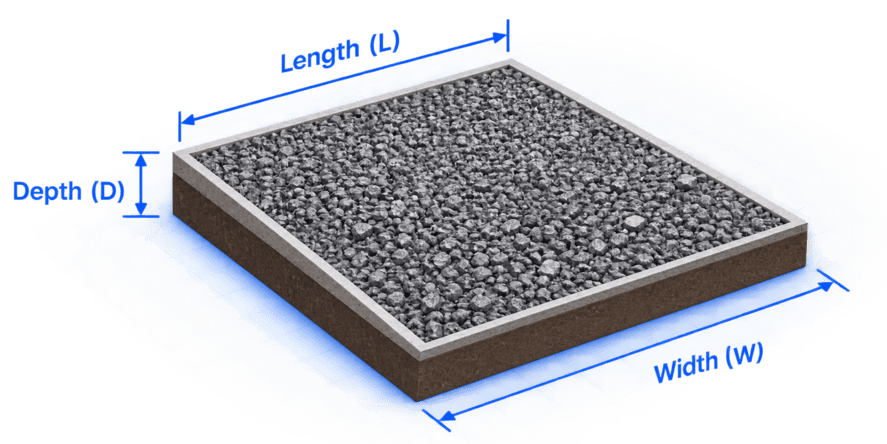
Accurate volume starts with clear length, width, and finished-depth measurements for each project area.
- 1Measure each footprint.
- 2Choose planned finished depth.
- 3Split irregular areas into rectangles.
- 4Confirm units and supplier terms.
Guide highlights
- Measured estimatesBuilt on documented formulas.
- Editable overageWaste is separate from compaction.
- Multiple SectionsOne calculator, every area.
Measure the Footprint
Measure the longest length and width of each rectangular area. If the project is irregular, divide it into practical rectangles and calculate them as separate areas.
Open the Gravel Calculator and add one row for each section. Area names are optional and help you read the breakdown.
Open Gravel CalculatorRepresentative Depth
Enter the planned finished depth, not the loose pile height. Length and width may be in feet while depth is in inches. The calculator converts every dimension into a shared unit automatically before multiplying.
volume = length × width × depth
Example: 12 ft × 12 ft × 3 in = 36 ft³ (1.333 yd³)
Waste Allowance
The calculator shows an editable 10% starting value. Waste covers measurement uncertainty, spillage, and irregular edges. Compaction is a separate physical change; set waste to 0% if you want raw geometric volume.
Cubic Yards ≠ Tons
Volume and weight are different physical metrics. Bulk density varies by gravel size, moisture, and compaction state.
QUICK REFERENCE
Unit conversion reference
| Measurement | Equivalent | Calculator Use |
|---|---|---|
| 12 inches | 1 foot | Depth can be entered directly in inches. |
| 3 feet | 1 yard | Length and width are entered in feet or metres. |
| 27 cubic feet | 1 cubic yard | Results show cubic feet, yards, and metres. |
| 100 centimetres | 1 metre | Depth can be entered directly in centimetres. |
When to ask the gravel supplier
Ask for the product-specific bulk density or short-tons-per-cubic-yard value when ordering by weight, and ask whether it describes loose or compacted material. Also confirm minimum delivery amounts, how the material is measured, and whether a separate compaction allowance is recommended for your project.
For road construction and maintenance context, see the FHWA Gravel Roads Construction and Maintenance Guide.
Measuring a garden bed or lawn uses the same length, width, and depth method. Use the topsoil calculator for cubic yards and bag quantities.
FAQ
Measurement questions
Reviewed September 7, 2026 · Formulexa editorial team
Calculation methodology →