

Formulexa
Percentage Calculation Overview
MATHEMATICAL PERCENTAGE SUITE

Percentage Calculator

Solve common percentage problems, calculate percentage increase or decrease, find percentage change, and reverse percentages with step-by-step mathematical formulas.

6 Calculation Modes
Step-by-Step Formulas
Zero Clamping Distortion
Percentage Calculator: Choose a calculation mode, enter the numbers, and see step-by-step mathematical results.

Choose the mathematical relationship you want to solve.

The percentage rate to calculate.

The whole number to take a percentage of.

6 Calculation Modes

Calculate P% of Y, what percent X is of Y, reverse percentages, percentage change, and symmetric difference.

Zero Clamping Guarantee

Reports mathematical percentages without artificially capping results to 100% or discarding negative rates.

Step-by-Step Breakdown

Displays the exact algebraic formula with substituted numbers for every calculation.

The 6 Essential Percentage Formulas

Percentages represent fractions of 100. Depending on which variable is unknown, you can rearrange the primary ratio into six fundamental calculation modes:

1. Percent of Value

(P ÷ 100) × Y

Find a fraction of a total amount (e.g. 15% tip on $50).

2. What Percent

(X ÷ Y) × 100

Determine the proportion of X relative to base Y.

3. Reverse Percent

X ÷ (P ÷ 100)

Calculate the initial whole when given a partial amount.

4. Increase / Decrease

Y ± (Y × (P ÷ 100))

Add or subtract a percentage markup or discount from a base.

5. Percentage Change

((New − Old) ÷ Old) × 100

Measure relative directional growth or contraction from a positive baseline.

6. Percentage Difference

|A − B| ÷ Avg × 100

Compare two peer measurements symmetrically without chronological order.

Worked Mathematical Examples

Example 1: Finding 20% of 150

Formula: (20 ÷ 100) × 150 = 0.20 × 150 = 30.

Example 2: What percent is 30 of 150?

Formula: (30 ÷ 150) × 100 = 0.20 × 100 = 20.00%.

Example 3: 30 is 20% of what number?

Formula: 30 ÷ (20 ÷ 100) = 30 ÷ 0.20 = 150.

Example 4: Percentage Change from 80 to 100

Formula: ((100 − 80) ÷ 80) × 100 = (20 ÷ 80) × 100 = +25.00% (Increase).

Mathematical Boundaries & Limitations

  • • Zero Denominator Restrictions: In Mode B (“X is what % of Y”), Y cannot equal zero because division by zero is mathematically undefined.
  • • Zero Percentage in Reverse Mode: In Mode C (“X is P% of what”), P cannot equal zero because no finite base multiplied by 0% yields a non-zero part.
  • • Baseline Sign in Percentage Change: Mode E requires a strictly positive initial value (> 0) in V1 to avoid ambiguous directional interpretations of negative baselines.
  • • Non-Invertibility of Symmetric Percentages: Increasing a number by 10% and then decreasing the result by 10% does NOT return the original value (e.g. 100 + 10 = 110, but 110 − 11 = 99).

Frequently Asked Questions

What is the formula to find a percentage of a number?
To find P% of a whole number Y, convert the percentage to a decimal by dividing by 100, then multiply by Y: Result = (P ÷ 100) × Y. For example, 20% of 150 is (20 ÷ 100) × 150 = 30.
How do I calculate what percentage one number is of another?
To find what percentage X is of Y, divide the part X by the whole Y, then multiply by 100: Percentage = (X ÷ Y) × 100. For example, 30 of 150 is (30 ÷ 150) × 100 = 20%. Note that the denominator Y cannot be zero.
What is a reverse percentage and how do I calculate it?
Reverse percentage finds the original base amount when you know a part and what percentage it represents. The formula is: Whole = Part ÷ (Percentage ÷ 100). For example, if 30 is 20% of a number, the whole is 30 ÷ (20 ÷ 100) = 30 ÷ 0.20 = 150.
What is the difference between percentage change and percentage difference?
Percentage change measures directional growth or reduction from a specific initial baseline: ((New − Old) ÷ Old) × 100. Percentage difference compares two peer numbers symmetrically without assuming an earlier or later baseline: |A − B| ÷ ((|A| + |B|) ÷ 2) × 100.
Can a percentage result exceed 100%?
Yes. In general mathematics and commerce, quantities frequently exceed their original baselines. For example, 250% of 40 is 100, and an increase from 50 to 150 represents a +200% change. Formulexa does not clamp general percentages to 100%.
Where should I go to calculate academic exam marks?
For student test scores, multiple subject marksheets, and target exam marks, use our specialized Marks Percentage Calculator at /students/marks-percentage-calculator/.
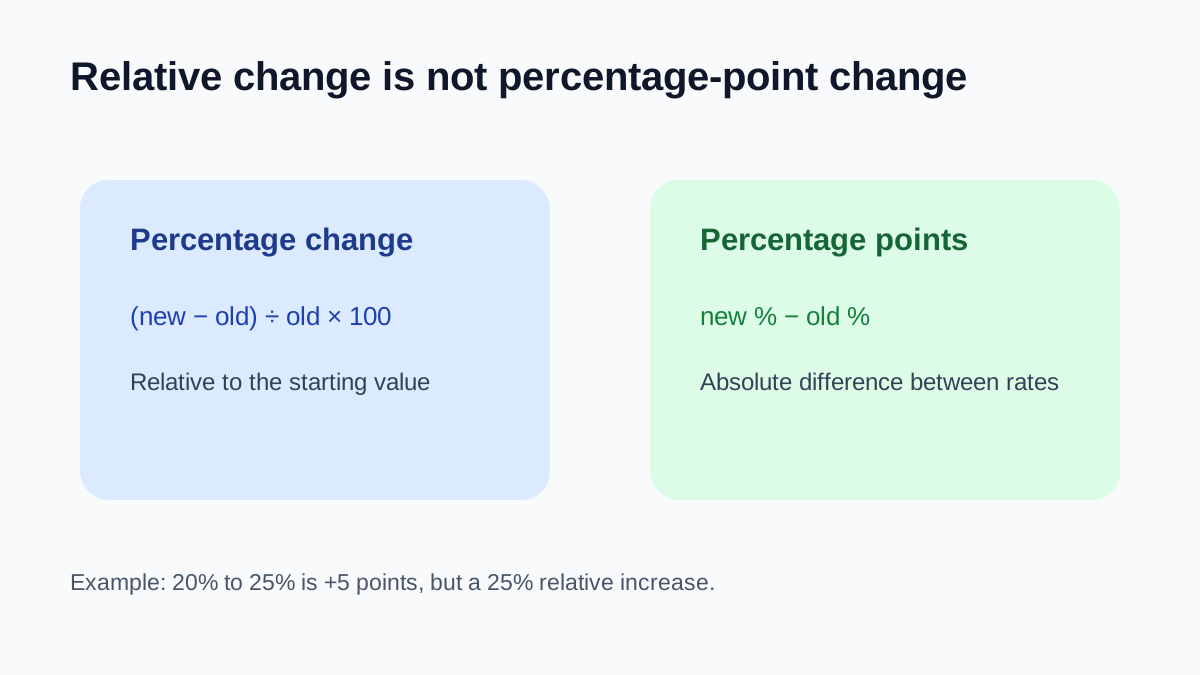
Diagram contrasting relative percentage change with absolute percentage-point difference.
Percentage change is relative to the starting value, while percentage points subtract one percentage rate from another.

Direct answer

Solve six common percentage relationships

A percentage calculator can find a percent of a number, determine what percent one value is of another, measure percentage increase or decrease, compare percentage difference, and reverse a percentage to recover the original whole. Each mode uses a different denominator, so selecting the relationship that matches the question is essential.

Core percentage methods

The tool selects the formula for the active mode. Percentage change uses the original value as its denominator, while percentage difference uses the average of both values and has no directional sign.

Percent of Y = Y × p/100; change = (new − old) ÷ old × 100

Variables used by Percentage Calculator
VariableMeaningUnit or range
pPercentage rate%
oldOriginal comparison valuenumber
newNew comparison valuenumber

Worked example

A price rising from 80 to 100 changes by (100 − 80) ÷ 80 × 100 = 25%. The percentage-point change between rates of 40% and 50% is 10 points, while their relative percentage increase is 25%.

How to read the result

A result answers only the selected relationship. Percentage points compare two percentages directly; percentage change measures a relative change. Division-based modes cannot use a zero denominator.

Included

  • ✓ Percent of a number
  • ✓ What-percent relationships
  • ✓ Increase/decrease and change
  • ✓ Percentage difference
  • ✓ Reverse percentage

Not included

  • — Academic marks aggregation
  • — Institutional grading policy
  • — Financial advice or compounding schedules

Common mistakes

  • Using the new value instead of the original as the change denominator.
  • Confusing percentage points with percent change.
  • Using percentage difference when direction matters.
  • Dividing by zero in what-percent or change modes.

Questions people ask

What is X percent of Y?

Convert X to a decimal and multiply it by Y.

What percent is X of Y?

Divide X by Y and multiply by 100, provided Y is not zero.

Change or difference?

Use percentage change for old-to-new movement and percentage difference for a directionless comparison.

How do I reverse a percentage?

Divide the known part by the percentage expressed as a decimal to recover the whole.