

Formulexa
EXAM & MARKSHEET PERCENTAGE CALCULATOR

Marks Percentage Calculator

Convert obtained and maximum marks into percentages for one exam or multiple subjects, handle unequal maximum marks accurately, and calculate marks needed for any target percentage.

Single & Multiple Subjects
Unequal Totals Supported
Target Marks Planner

Marks percentage calculator highlights

Accurate Ratio MathematicsComputes exact sum-of-marks percentages without rounding distortion.
Unequal Maximum MarksSupports subjects with varying totals (e.g. 50, 75, 100).
Reverse Target PlannerDetermine exact and minimum integer marks for your desired score.

Enter raw marks obtained and total available marks. All calculations use exact ratio arithmetic without regional grade-band assumptions.

Single Exam Percentage

Enter the marks you scored and the maximum marks available. Fractional marks (e.g. 37.5) are supported.

Points or marks scored

Total marks out of

Ready to Calculate

Enter your marks and click calculate to view the exact percentage, marks lost, breakdown, and normalized score.

Why Averaging Subject Percentages Can Distort Your Overall Score

A very common student mistake is calculating each subject's percentage separately and then taking the simple average. When subjects have different maximum marks (e.g. 50 vs. 100), simple averaging improperly gives a 50-mark exam the same mathematical weight as a 100-mark paper.

Worked Counter-Example:
  • • Subject A: 45 / 50 marks = 90.00%
  • • Subject B: 80 / 100 marks = 80.00%
  • • Arithmetic mean of percentages: (90% + 80%) ÷ 2 = 85.00%
  • • Raw-total percentage: (45 + 80) ÷ (50 + 100) = 125 ÷ 150 = 83.33%

The Formulexa calculator calculates raw-total percentage by dividing total obtained by total maximum, weighting each subject by its maximum marks. Check your institution's guidelines if a specific board formula is required.

How to calculate percentage from marks

A percentage is a ratio normalized to a base of 100. When calculating your percentage from an academic test, examination, or assignment, you need two fundamental numbers:

Numerator

Marks Obtained

The actual points, score, or marks awarded to you on your assessment, including any fractional marks.

Denominator

Maximum Total Marks

The full marks possible on the test if every question was answered completely correctly.

Percentage (%) = (Marks Obtained ÷ Maximum Marks) × 100

Overall percentage for multiple subjects

If you want a raw-total percentage across several subjects, aggregate the obtained marks and maximum marks separately. The raw-total percentage formula sums both columns:

Overall Percentage (%) = (Σ Obtained Marks ÷ Σ Maximum Marks) × 100

Subjects with equal maximum marks

If every subject on your marksheet is graded out of the same maximum total (for example, 5 subjects each out of 100 marks), calculating the overall percentage through the total marks method yields the exact same result as taking the simple average of the subject percentages. For 5 subjects of 100 marks each, the denominator is 500.

Subjects with different maximum marks

Subjects can be evaluated out of different maximum totals—such as 50, 75, or 100 marks. For the raw-total method, sum all obtained marks and divide by the sum of all maximum marks. Do not substitute the simple mean of subject percentages when your goal is specifically a raw-total percentage. If an institution defines equal subject weighting or another method, follow that official policy.

How to calculate marks from a target percentage

If you have a target goal—such as needing 75% for college admission eligibility, or 80% to retain a scholarship—you can invert the percentage formula to find exactly how many marks you must score:

Required Marks = (Target Percentage ÷ 100) × Total Marks

Understanding Fractional vs. Whole Mark Requirements

If the exact formula produces a decimal value (e.g. needing 83% out of 75 marks yields exactly 62.25 marks), and your examiner only awards whole integer marks, scoring 62 marks would give you 82.67%, falling short of your 83% threshold. In whole-mark environments, you must round up to the next integer (63 marks) to guarantee meeting your goal.

Worked examples

Example 1: Single Exam

425 Out of 500

Obtained: 425
Maximum: 500
Calculation: (425 ÷ 500) × 100
Result = 85.00%
Marks Lost: 75

Example 2: Unequal Subjects

3 Subjects (50, 100, 75)

Scores: 45/50, 85/100, 68/75
Sum Obtained: 198
Sum Maximum: 225
Calculation: (198 ÷ 225) × 100
Result = 88.00%

Example 3: Target Marks

80% of 550 Total

Target: 80%
Total Marks: 550
Calculation: (80 ÷ 100) × 550
Result = 440 Marks
Permitted Lost Marks: 110

Marks vs. Percentage vs. Percentile

Students and parents frequently encounter these three terms on scorecards, competitive entrance exams, and college admissions. Here is how they differ:

TermDefinitionExampleDependent On Peers?
MarksRaw points earned on an evaluation.85 points out of 100No
PercentageProportion of total marks earned, scaled out of 100.85%No
PercentileRelative rank indicating percentage of candidates who scored equal to or below you.98th percentile (scored higher than 98% of peers)Yes

Common mistakes to avoid

Averaging Unequal Percentages

Taking the average of percentages across papers with different totals (e.g., 50 and 100 marks) skews the overall aggregate. For a raw-total percentage, add the obtained marks and maximum marks separately, then divide the two totals.

Assuming Universal Pass Marks

Assuming that 33%, 35%, or 40% is universally a passing score leads to errors. Some boards require separate passing grades in theory and practical components.

Omitting Internal Assessment

Include theory, practical, internal, assignment, or other components only when they are part of the total you intend to calculate. For an official reported percentage, follow the relevant institution or board policy.

Applying Best-of-Five Prematurely

Excluding subjects (such as optional 6th papers) before confirming the specific admission rules of your university or employer can lead to invalid application submissions.

Frequently asked questions

How do I calculate percentage from marks?
To calculate percentage from marks, divide the marks you obtained by the total maximum marks available, and multiply the result by 100. For example, if you scored 425 marks out of 500, the calculation is (425 ÷ 500) × 100 = 85%.
How do I calculate overall percentage for multiple subjects?
To find your overall marks percentage across several subjects, add all the marks you obtained across all subjects together, then add all the maximum possible marks together. Finally, divide your total obtained marks by the total maximum marks and multiply by 100: (Total Obtained ÷ Total Maximum) × 100.
Can subjects have different total marks?
Yes. Subjects or assessment components can have different maximum marks. For a raw-total percentage, the calculator adds the obtained marks and maximum marks separately before calculating the ratio.
Should I average subject percentages?
When every subject has the same maximum mark, the arithmetic mean of the individual subject percentages equals the raw-total percentage. When subject maximum marks differ, the arithmetic mean of subject percentages and the raw-total percentage generally differ because the raw-total method weights each subject by its maximum marks. An institution may define its own weighting or reporting method, so follow the relevant official policy when an official percentage is required.
How do I calculate marks from a target percentage?
To find the marks needed for a desired percentage, divide your target percentage by 100 and multiply by the total available marks: (Target Percentage ÷ 100) × Total Marks. For example, to secure 80% out of 500 total marks, you need (80 ÷ 100) × 500 = 400 marks.
Can I enter decimal marks?
Yes. Our calculator accepts decimal and fractional marks (such as 37.5 out of 50 or 88.25 out of 100), which are common in assessments that award negative marking or fractional marks for lab work and internal tests.
Why doesn't the calculator show a letter grade?
Letter grade boundaries (such as A, B, C, distinctions, or divisions) vary significantly between examination boards, universities, and countries. Rather than assuming an arbitrary grading scale, our calculator provides pure, accurate mathematical percentages that you can compare against your institution's specific grade handbook.
Is percentage the same as percentile?
No. Percentage is an absolute score representing the proportion of marks you earned out of total available marks (e.g. 85% means you earned 85% of the points). Percentile is a relative rank showing the percentage of candidates who scored below you in an exam (e.g. the 95th percentile means you scored higher than 95% of test-takers).
Can I use this calculator for 5, 6, or more subjects?
Yes. You can add up to 50 individual subject rows in the Multiple Subjects mode. This accommodates 5-subject marksheets, 6-subject high school curricula, college semester course loads, and modular assessment programs.
Can I use this for school, college, or university marks?
The calculator can compute a mathematical percentage from the obtained and maximum marks you enter. Whether that result is the official percentage used by a school, examination board, university, employer, or admissions office depends on that authority's published rules.
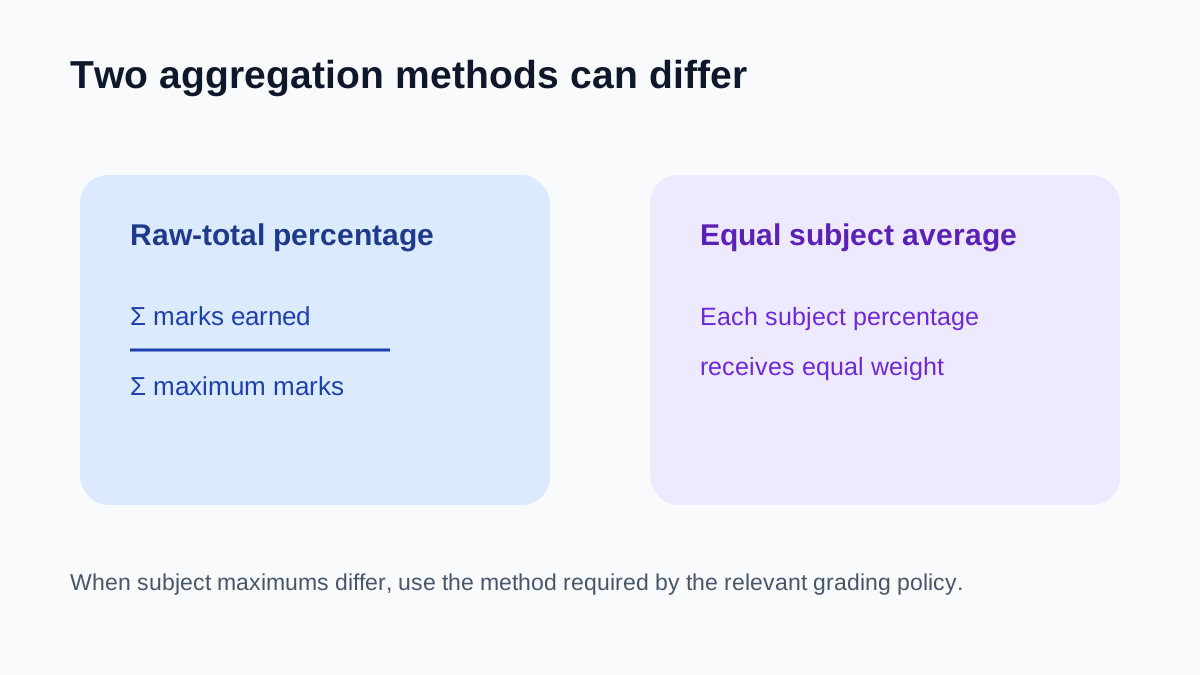
Diagram comparing raw-total marks percentage with an equal average of subject percentages.
When subject maximum marks differ, the methods can produce different results; use the method required by the relevant grading policy.

Direct answer

Calculate exam or all-subject percentage from marks

A marks percentage calculator divides obtained marks by maximum marks and multiplies by 100. For multiple subjects with unequal maximums, the raw-total method sums obtained marks and maximum marks before dividing. An institution may prescribe a different aggregation or rounding policy, so the calculator reports the mathematical result rather than declaring an official academic outcome.

Raw-total marks formula

Summing raw marks preserves the influence of subjects with different maximum marks. A simple average of subject percentages is equivalent only when every subject has the same maximum or policy assigns equal subject weight.

Overall percentage = Σ obtained marks ÷ Σ maximum marks × 100

Variables used by Marks Percentage Calculator
VariableMeaningUnit or range
obtainedMarks earned in each subjectmarks
maximumMaximum available marksmarks
ΣSum across included subjects—

Worked example

Scores of 72/80 and 135/150 give 207 obtained marks out of 230. The raw-total percentage is 207 ÷ 230 × 100 = 90%. Averaging the two subject percentages instead would assign equal weight despite different maximums.

How to read the result

The result is the aggregate share of available marks earned across the entered subjects. It is not automatically an official grade, GPA, rank, or institution-approved conversion.

Included

  • ✓ Single-exam percentage
  • ✓ Multiple-subject raw totals
  • ✓ Unequal maximum marks
  • ✓ Target-marks calculation supported by the tool

Not included

  • — Automatic institutional weighting
  • — GPA/CGPA conversion policy
  • — Grade boundaries or transcript rounding

Common mistakes

  • Averaging subject percentages when maximum marks differ.
  • Entering obtained marks greater than the stated maximum.
  • Treating mathematical percentage as an official institution aggregate.
  • Rounding each subject before summing raw marks.

Questions people ask

How do I calculate percentage from marks?

Divide obtained marks by maximum marks and multiply by 100.

Should I average subject percentages?

Only when subjects are intended to have equal weight; otherwise use summed raw marks and maximums.

How do unequal maximum marks affect the result?

A subject with more available marks contributes more to the raw-total percentage.

What marks do I need for a target?

The target mode reverses the percentage formula and applies the calculator’s documented whole-mark handling.